
Data Governance Tools

Build governance in from day one—so your data is trusted, reusable, and ready to scale.
Consent and permissible use

Open Brain Consent
Open Brain Consent is a framework that helps researchers design consent processes for sharing human brain imaging data in ways that are ethical, transparent, and aligned with participants’ expectations. It provides standardized language and guidance to enable open data sharing while clearly communicating potential risks, privacy considerations, and future data use.
Data standards & metadata
BIDS
BIDS is the Brain Imaging Data Structure, a simple way of standardizing and organizing brain data. BIDS can be used for MRI, EEG, MEG, PET, NIRS, and other types of brain data. The community driven standard continues to grow and evolve based on research needs and feedback.
NWB
NWB is Neurodata without Borders, a standard for neurophysiology, providing neuroscientists with a common standard to share, archive, use, and build analysis tools for neurophysiology data. NWB is designed to store a variety of neurophysiology data, including data from intracellular electrophysiology experiments, data from optical physiology experiments, and tracking and stimulus data.

OpenMINDS
OpenMINDS is a neuroscience metadata framework covering datasets, subjects, specimens, licences, protocols, provenance, anatomical locations, and controlled terminology.
Provenance and accountability

DataLad
DataLad aims to provide all tools necessary to create and publish data distributions — an analog to software distributions or app-stores that provide logistics middleware for software deployment. Scientific communities can use these tools to gather, curate, and make publicly available specialized collections of datasets for specific research topics or data modalities.
Indigenous and community data governance
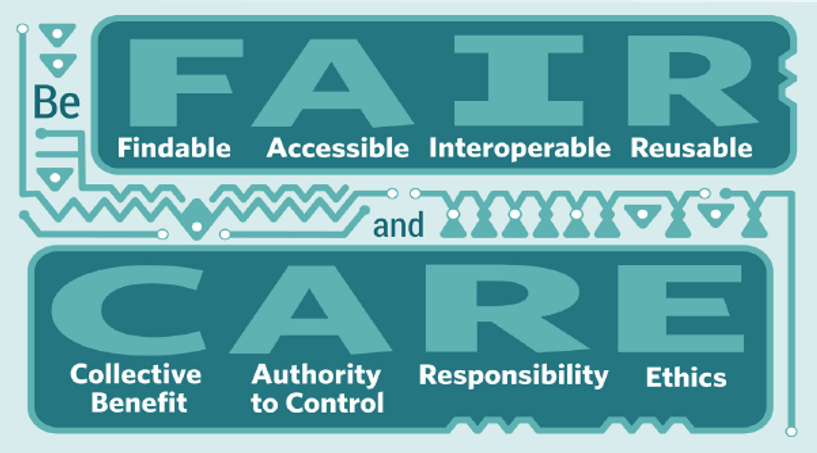
CARE Principles
The CARE Principles for Indigenous Data Governance — Adds the collective and community dimensions often missing from individual-consent frameworks: Collective Benefit, Authority to Control, Responsibility, and Ethics. Particularly important for multinational and Indigenous-partnered research.